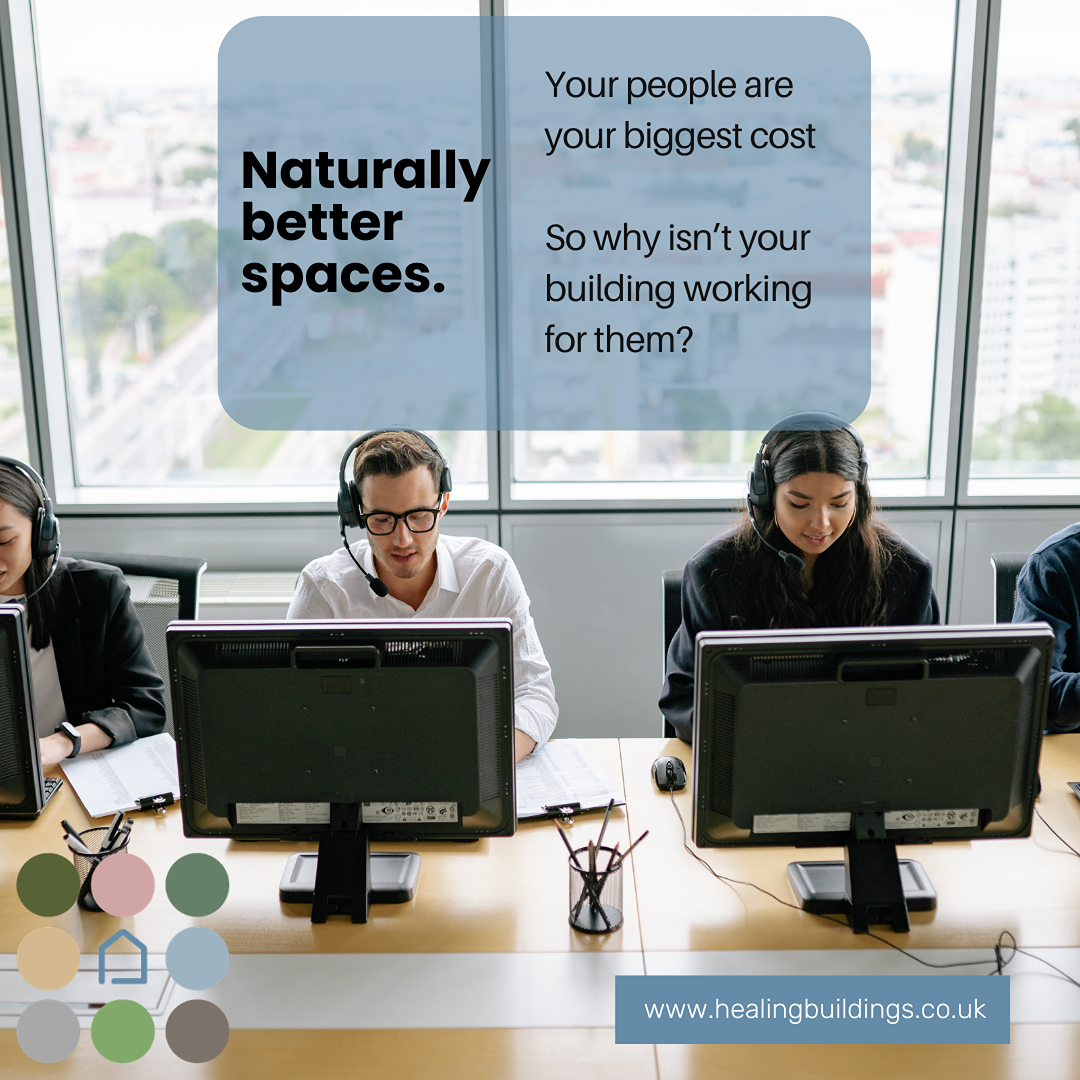
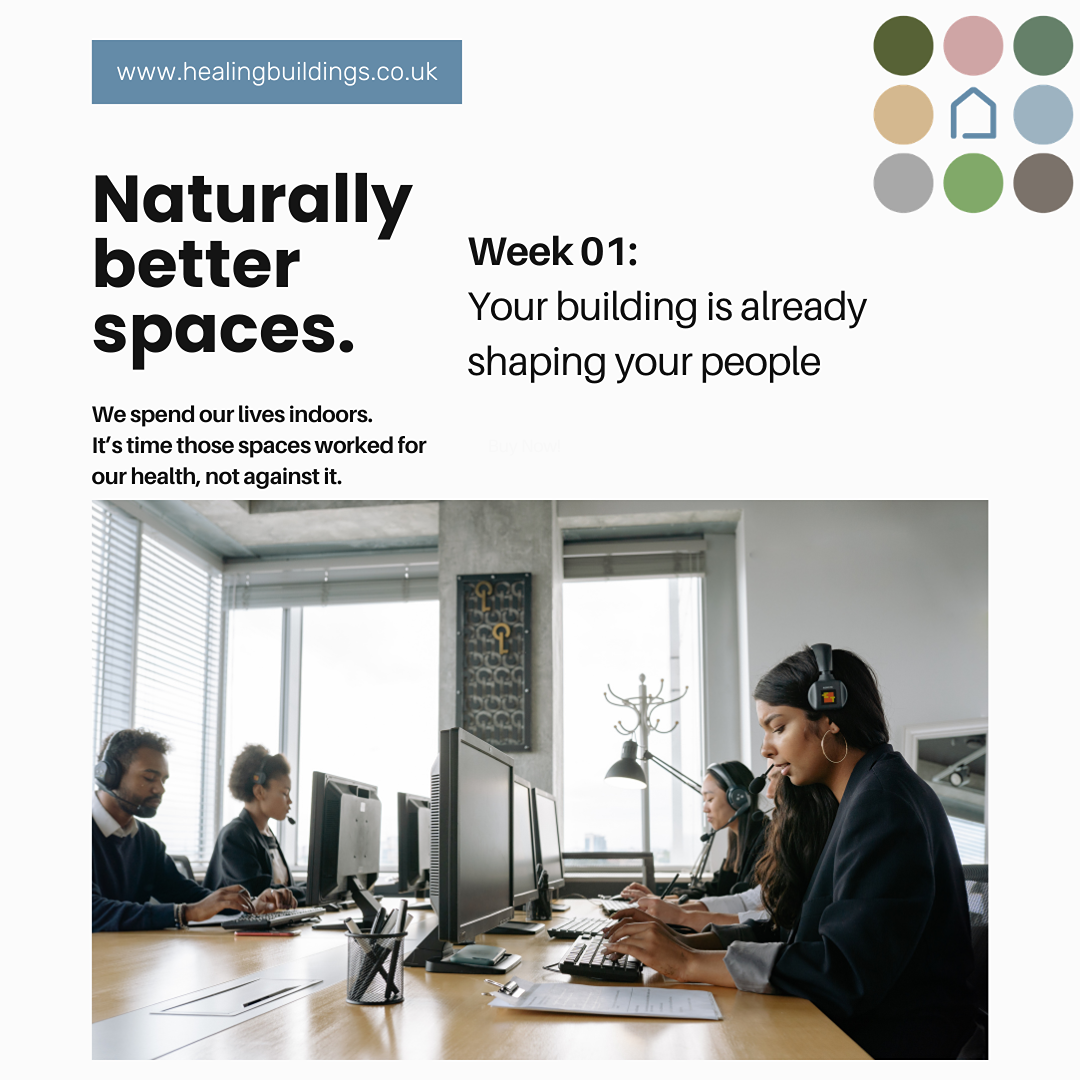
Naturally Better Spaces Week 01

INTRODUCTION
We like to think we work in buildings. We don’t. We live in them. We spend around 90% of our time indoors. Offices. Homes. Schools. Meeting rooms. Cars. Gyms. Airports. Screens inside spaces inside systems. Layer upon layer of “inside.” And yet, most buildings are not designed for the one thing that matters most.
People.
They are designed for energy targets. For cost efficiency. For compliance. For programme. For aesthetics. Sometimes for awards.
Rarely for health.
And almost never for performance in the way businesses actually measure it.
Focus. Productivity. Retention. Absence. Cognitive clarity. Decision-making.
This series, Naturally Better Spaces, is about shifting that.
Because buildings are not neutral. They are not passive containers. They are active systems that are either supporting the people inside them… or quietly working against them.
At Healing Buildings, we position buildings as health infrastructure.
That might sound abstract. It isn’t. If your employees are tired, distracted, uncomfortable, or unwell… your building is part of that equation. If your employees are focused, energised, and performing well… your building is part of that too.
Over the next 12 weeks, I’m going to break this down.
Practically. Commercially. Honestly.
And if you’re responsible for a workplace, a portfolio, or a team… this isn’t just interesting. It’s expensive if you ignore it.
1. The Shift No One Accounted For
We didn’t design ourselves into this. It just happened. We moved indoors for convenience. For control. For comfort. For productivity. Then we stayed there. Now we are an indoor species. And here’s the problem. Our biology didn’t get the memo.
We are still wired for movement.
For variation.
For fresh air.
For daylight.
For complexity.
For sensory richness.
Instead, we sit in:
Air that doesn’t move enough
Light that doesn’t change enough
Temperatures that don’t vary enough
Spaces that don’t stimulate enough
Or worse, spaces that overstimulate in all the wrong ways. Noise. Glare. Chemical exposure. Poor air. It’s not dramatic. It’s not obvious. It’s just… constant.
2. Your Building Is Already Affecting Performance
Whether you measure it or not. Every building is running a silent background programme. Air quality. Light. Acoustics. Thermal comfort. Materials. Together, they shape how people think and feel. The indoor environments directly influence physical, mental, and emotional health. Let’s translate that into business language.
They influence:
Cognitive function
Decision-making speed
Error rates
Collaboration
Fatigue
Poor indoor air quality alone is linked to headaches, reduced concentration, and lower productivity. Not dramatic illness. Just enough underperformance to cost you… every day.
3. The Signals Are There. You’re Just Not Calling Them Out
No one walks into a meeting and says:
“The CO₂ levels are too high in here.”
They say:
“I’m exhausted.”
“This room is stuffy.”
These are not personal failings. They are environmental signals. And most organisations absorb them as “normal.” They are not normal. They are design outcomes.
4. Let’s Talk Money (Because That’s What Moves Things)
Here’s the uncomfortable truth. You don’t have a building problem. You have a people cost problem that your building is influencing.
The 3-30-300 rule is simple:
3% = energy
30% = rent
300% = people
And yet most decisions still focus on the 3%. If your building improves productivity by even a few percent, the financial return dwarfs almost any capital investment.
The guide highlights links between healthy buildings and:
Increased productivity
Reduced absenteeism
Improved retention
That’s not soft value
5. This Is Not About Perfection. It’s About Awareness
You don’t need a new building. You need a new lens. Most existing buildings are full of untapped potential.
Small, targeted changes can unlock real value:
Better ventilation strategies
Smarter lighting
Reduced chemical exposure
Improved acoustic zoning
Introducing nature where it actually matters
This is not about “wellbeing fluff.”
This is about performance engineering for people.
6. Where I Come In
This is exactly why I do what I do.
At Healing Buildings, I help organisations:
Understand what their buildings are actually doing
Identify hidden risks and missed opportunities
Turn insight into practical, measurable change
There are two ways to engage with this.
Option 1: Help me write the book
I’m writing a book that pulls this entire thinking together. Clear. Practical. No jargon.
Something you can hand to a leadership team and say: “Read this. Then we need to talk.”
Option 2: Start With a Workshop (Now)
If you don’t want to wait, this is where we start.
A Healthy Building Workshop.
We look at your space. Your people. Your challenges. We unpack what’s working. What isn’t. And where the opportunities sit. By the end, you don’t just “know more.”
You have a direction. And importantly, you have something you can take back into the business and act on.
CONCLUSION
If you take one thing from this, let it be this. Your building is not neutral.
It is shaping your people every single day.
Quietly. Consistently. Relentlessly.
The question is whether it’s doing that well… or badly.
And whether you are choosing to ignore it.
Because once you see it, you can’t unsee it.
You start noticing the stuffy meeting room.
The harsh lighting.
The noise that never quite settles.
And then the question becomes:
What are we going to do about it?
This series will give you the language, the evidence, and the practical steps to start answering that.
But if you already know something isn’t right in your space…
Don’t wait 12 weeks.
👉 Start with a workshop
👉 Or keep an eye out for the book
Either way, this is the conversation your business needs to be having.