
Natural Better Buildings Week 02
NATURALLY BETTER SPACES Week 02
The Economics of Healthy Buildings (You’re Already Paying for It)
Last week, I said something that tends to make people pause. We are now an indoor species. It sounds philosophical. Almost abstract. It isn’t. It’s financial.
Because if your people spend most of their time inside buildings, then those buildings are directly influencing how they perform. How they think. How they collaborate. How they show up. And that means one thing. Your building is already part of your cost structure.
This is where the conversation around healthy buildings often goes wrong. It gets framed as wellbeing. As something soft. Optional. A “nice to have” once everything else is sorted.
But when you strip it back, this is not a wellbeing conversation.
It’s a performance conversation.
And more importantly, it’s an economic one.
At Healing Buildings, this is where I start with clients. Not with plants. Not with aesthetics. Not even with design.
With cost.
Because the moment you understand how buildings influence people, and how people drive business performance, the question shifts.
It’s no longer:
“Can we afford to invest in healthier buildings?”
It becomes:
“Why are we not already doing this?”
1. The Number Everyone Knows (But Rarely Uses Properly)
Let’s start with something simple.
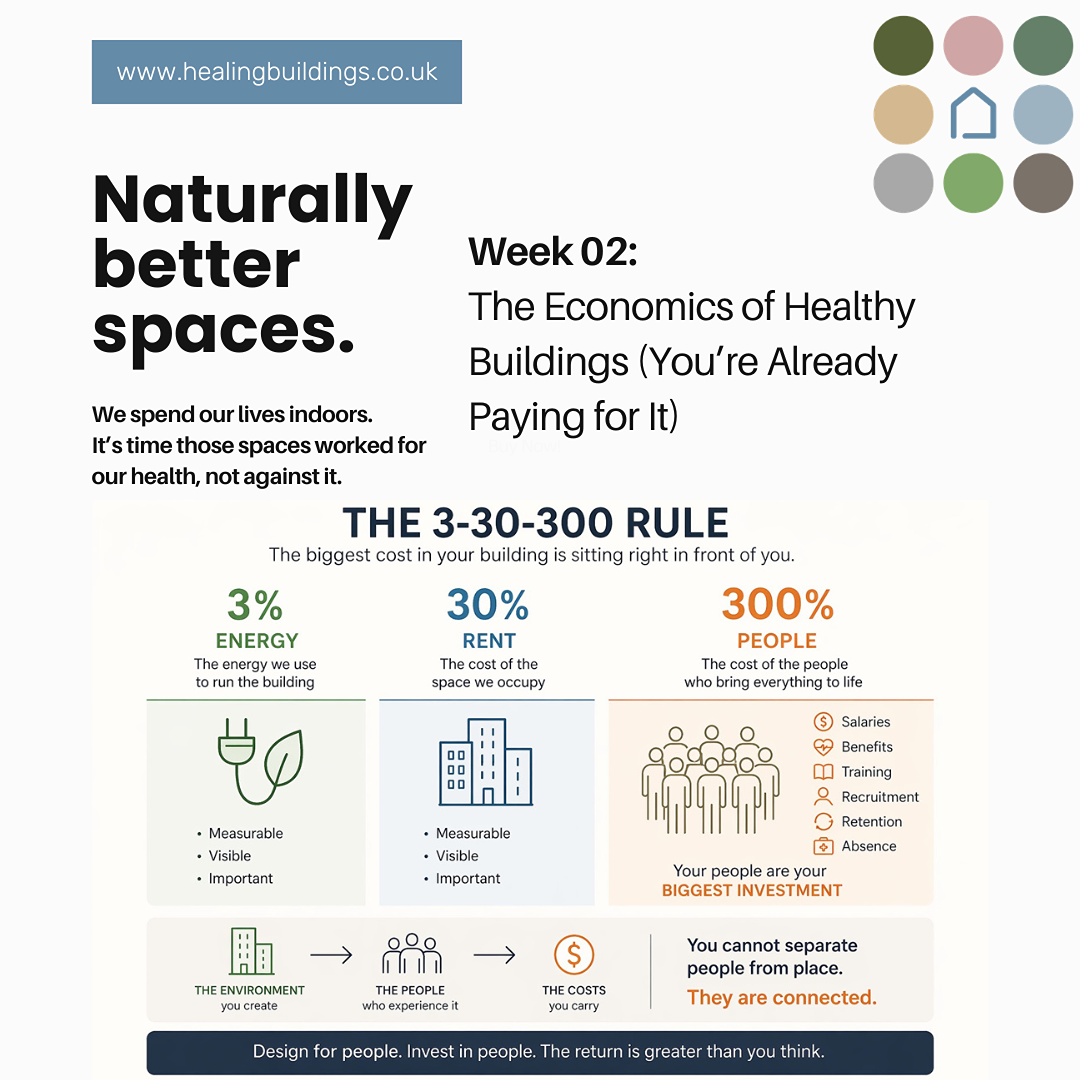
The 3-30-300 rule.
3% = energy
30% = rent
300% = people
It’s widely quoted. Frequently presented. Often nodded at.
Then ignored.
Because most building decisions still focus on:
Reducing energy use
Managing capital cost
Controlling rent
All important. All measurable. All visible.
But the biggest cost in your building is sitting right in front of you.
Your people - Salaries. Benefits. Training. Retention. Recruitment. Absence.
And yet, we rarely connect those costs back to the environment those people are working in.
We treat people as separate from place.
They are not.
2. Performance Is Not Just About People. It’s About Conditions
If you take two identical teams and place them in two different environments, you will not get the same output.
You will get:
Different levels of focus
Different levels of fatigue
Different levels of engagement
This is not hypothetical. Indoor environmental quality affects:
Cognitive function
Decision-making
Error rates
Collaboration
So the question becomes: Why are we still treating buildings as neutral?
3. The Hidden Cost You’re Not Measuring
Most organisations track:
Energy bills
Rent per square metre
Headcount
Few track:
Cognitive performance
Environmental fatigue
Decision quality linked to space
So the cost doesn’t show up as a line item.
It shows up as:
Slower work
More mistakes
Lower engagement
Quiet attrition
Let’s make this tangible.
If poor indoor conditions reduce productivity by even 2–3%, the financial impact across a workforce is significant.
And that’s before you factor in:
Absenteeism
Presenteeism
Staff turnover
The guide points to reduced absenteeism and improved retention as outcomes of healthier buildings .
This is not marginal.
This is structural.
4. The Cost of Doing Nothing
Doing nothing feels safe.
No capital spend. No disruption. No change.
But doing nothing is still a decision.
And it has a cost.
You are choosing to:
Accept suboptimal performance
Absorb avoidable inefficiencies
Normalise environments that are not supporting your people
Over time, that compounds.
Quietly. Consistently.
And because it’s not measured directly, it rarely gets challenged.
5. Healthy Buildings Are Not Expensive. Ignoring Them Is
There’s a misconception that healthy buildings require large capital investment.
Sometimes they do.
Often, they don’t.
Many improvements are:
Low cost
Behavioural
Operational
Things like:
Adjusting ventilation strategies
Improving lighting quality
Reducing chemical exposure
Rethinking layouts and noise
The issue is not cost.
It’s awareness.
You can’t improve what you’re not looking at.
6. This Is Where Strategy Comes In
This is not about random interventions.
It’s about understanding:
What your building is doing now
Where the risks are
Where the opportunities sit
At Healing Buildings, this is exactly the work.
And it always starts in the same place.
Not with design.
With understanding.
7. Two Ways Into This (And Why It Matters Now)
If you’re reading this and thinking:
“We should probably look at this…”
You’re right.
There are two ways to start.
Option 1: The Book (Build Understanding First)
I’m currently starting to writing a book that pulls this entire conversation together.
Clear. Direct. Practical.
Something that helps leadership teams understand:
Why this matters
Where the risks sit
How to think about buildings differently
It’s designed to shift mindset.
Option 2: The Workshop (Turn Thinking Into Action)
If you don’t want to wait, this is where the real work starts.
A Healthy Building Performance Workshop.
We take your building, your context, your people.
And we unpack:
What’s working
What’s not
Where the economic opportunities sit
This is not theoretical.
By the end, you have:
Clarity
Direction
A starting point for change
And importantly, something you can take back into the business and justify.
8. From Workshop to Audit (Where the Value Deepens)
For organisations ready to go further, this leads into:
Healthy Building Audits
This is where we:
Assess the environment in detail
Identify specific risks and inefficiencies
Provide targeted recommendations
This is where the “hidden cost” becomes visible.
And once it’s visible, it becomes actionable.
CONCLUSION + CTA
Let’s bring this back to a simple point.
Your building is already costing you money.
Not just in rent. Not just in energy.
In performance.
In productivity.
In people.
The question is not whether you are paying for it.
You are.
The question is whether you are getting value from it.
Because right now, most organisations are leaving that value on the table.
Not intentionally.
Just because they haven’t looked.
But once you start looking, the conversation changes.
You start asking different questions.
You start seeing different things.
And you start realising how much potential sits in the spaces you already have.
So here’s the challenge:
If your people are your biggest cost, what is your building doing to support them?
If you don’t have a clear answer…
Start with the workshop
Or wait for the book
Either way, this is not a conversation to park.
Because the cost of ignoring it is already showing up.
You’re just not calling it that yet.
Click on this text to start editing and enter your own text with some basic formatting. Just click anywhere outside the text box when you're done to continue working on the rest of your page. Elements like this text can often be hidden in the block settings.