
From Safety to Salutogenesis - Where we come together
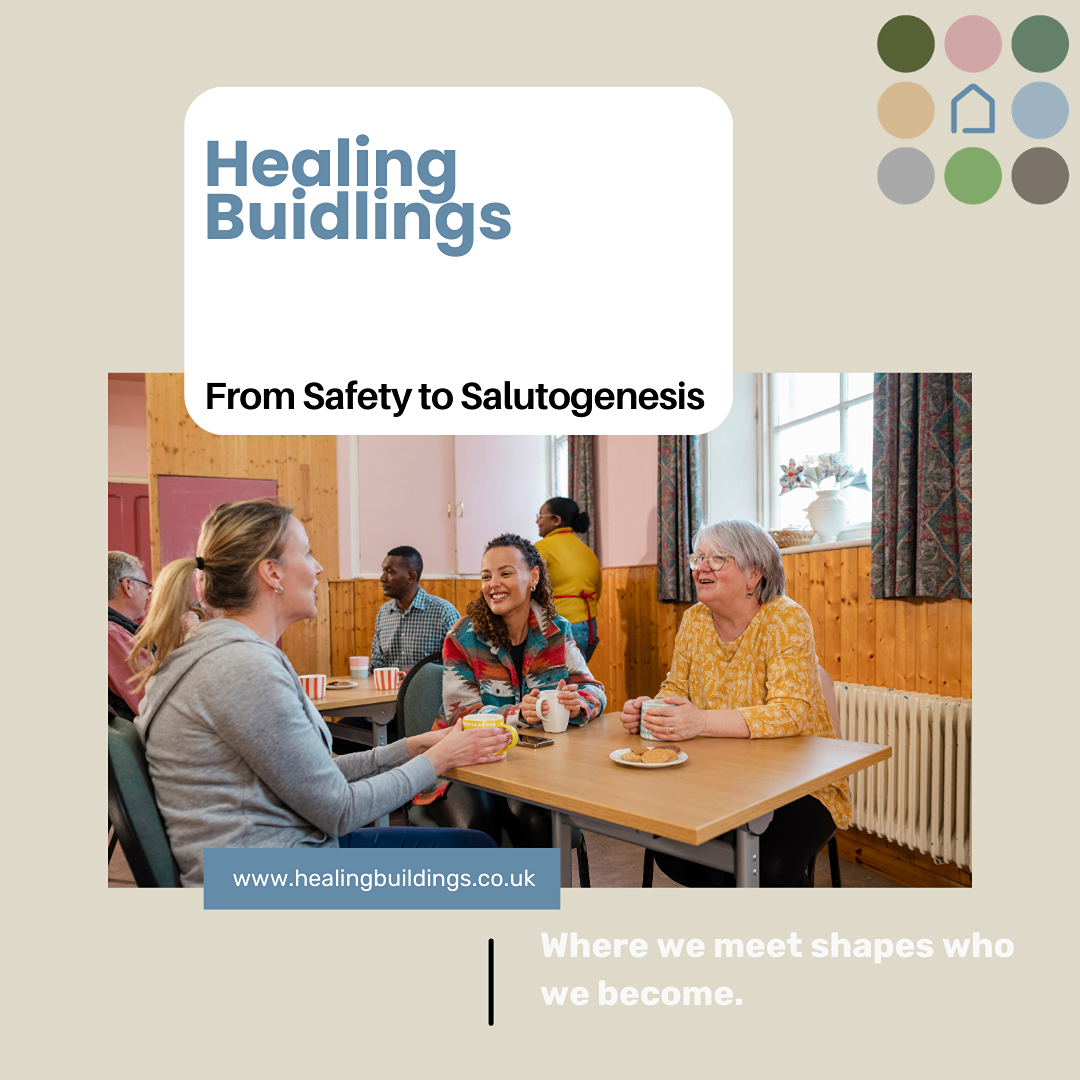
Last week I explored the idea that buildings are not neutral. They shape our health, our behaviours and our everyday experiences in ways we are only just beginning to fully understand. This week, I want to move the conversation outward. Because health is not just individual, it is collective. And the spaces where we come together play a critical role in shaping that.
We often describe buildings in terms of function. A school is for learning, an office is for working, a community hall is for events. But this language flattens something far more complex. These are not just functional spaces, they are social ecosystems. They shape how we meet, how we interact, how we feel about belonging and whether we experience connection or isolation. In this sense, they are quietly shaping our health every single day.
There is a growing and often unspoken crisis of disconnection. More people are living alone, informal community spaces are disappearing, and while we are more digitally connected than ever, we are often less physically present with one another. Many of the spaces we now inhabit are transactional or controlled, places where our presence is tied to spending, purpose or permission. The everyday, unstructured places where people can simply exist together are becoming harder to find. Yet it is often in these in-between spaces that community is formed.
Design plays a subtle but powerful role in this. Not all spaces invite connection; some actively discourage it. The orientation of a bench, the openness of a threshold, the speed of a street, these decisions influence whether people pause, make eye contact, start a conversation or move straight through. Individually these choices seem small, but together they shape the social life of a place. Design, in this sense, is not just about form or function, it is about encounter.
Historically, communities were anchored by shared spaces. Markets, town squares, libraries, parks and local halls provided a common ground where different lives overlapped. These spaces were rarely perfect, but they offered something essential, a sense of shared ownership and presence. Today, many of these spaces are under pressure. Funding cuts, redevelopment and changing priorities have reduced or fragmented the environments where community life once unfolded. In their place, we often see spaces that are highly controlled or commercialised, where people are positioned as customers rather than citizens.
If we begin to understand health more broadly, it becomes clear that it does not only sit within the individual. Health happens between us. It is shaped by relationships, by trust, by moments of interaction and by the feeling that we belong somewhere. Research increasingly links social connection to improved mental and physical health, to resilience and to recovery. And yet, these outcomes are rarely considered explicitly in design processes. We measure efficiency, density and performance, but far less attention is given to connection, belonging or social wellbeing.
This raises a different kind of design question. What if, at the very beginning of a project, we asked where people come together? Not as an afterthought or a leftover space, but as a central driver of the design. This might shift how we think about thresholds between public and private, about shared spaces within housing, about streets that prioritise people rather than vehicles, or workplaces that allow for informal interaction rather than purely task-based activity. It is not about forcing connection, but about creating the conditions where it can emerge naturally.
There are already examples that show this is possible. Community-led projects, cooperatives and local hubs often succeed because they are shaped through participation. They are not imposed solutions, but evolving places that respond to the people who use them. These environments recognise that community cannot be fully designed in advance. It needs space to grow, adapt and change over time.
As with health, there is a gap in how we teach this within the built environment professions. Education often focuses on individual buildings rather than the relationships between people and place. Designing for connection requires a different set of skills. It asks us to understand behaviour, to engage with communities, and to think beyond the moment of completion. These are not secondary considerations. They are fundamental to creating places that support wellbeing.
There is also an important distinction between space and place. We can design and deliver space, but place is something that emerges. It carries meaning, memory and identity. It is shaped not just by what is built, but by how it is used, cared for and shared. The places where we come together are never truly finished. In many ways, they only begin once people start to inhabit them.
Next week, I want to step into the space we so often forget. Not the buildings themselves, but the spaces between them. The streets, thresholds, edges, landscapes and overlooked fragments that shape how we move, meet and feel in the world around us. These outside spaces are not secondary, they are the connective tissue of our environments. They hold the potential for movement, encounter, rest and restoration. If we are serious about health in the built environment, we cannot stop at the building line. We have to look at everything in between.
Through Healing Buildings, this work continues to explore how we design not just for individuals, but for communities. Because a healthy building is not simply one that supports the person inside it. It is one that strengthens the relationships between people. One that creates space for connection, for conversation and for community.
Because ultimately, health is not something we experience alone. It is something we build together.

Click on this text to start editing and enter your own text with some basic formatting. Just click anywhere outside the text box when you're done to continue working on the rest of your page.