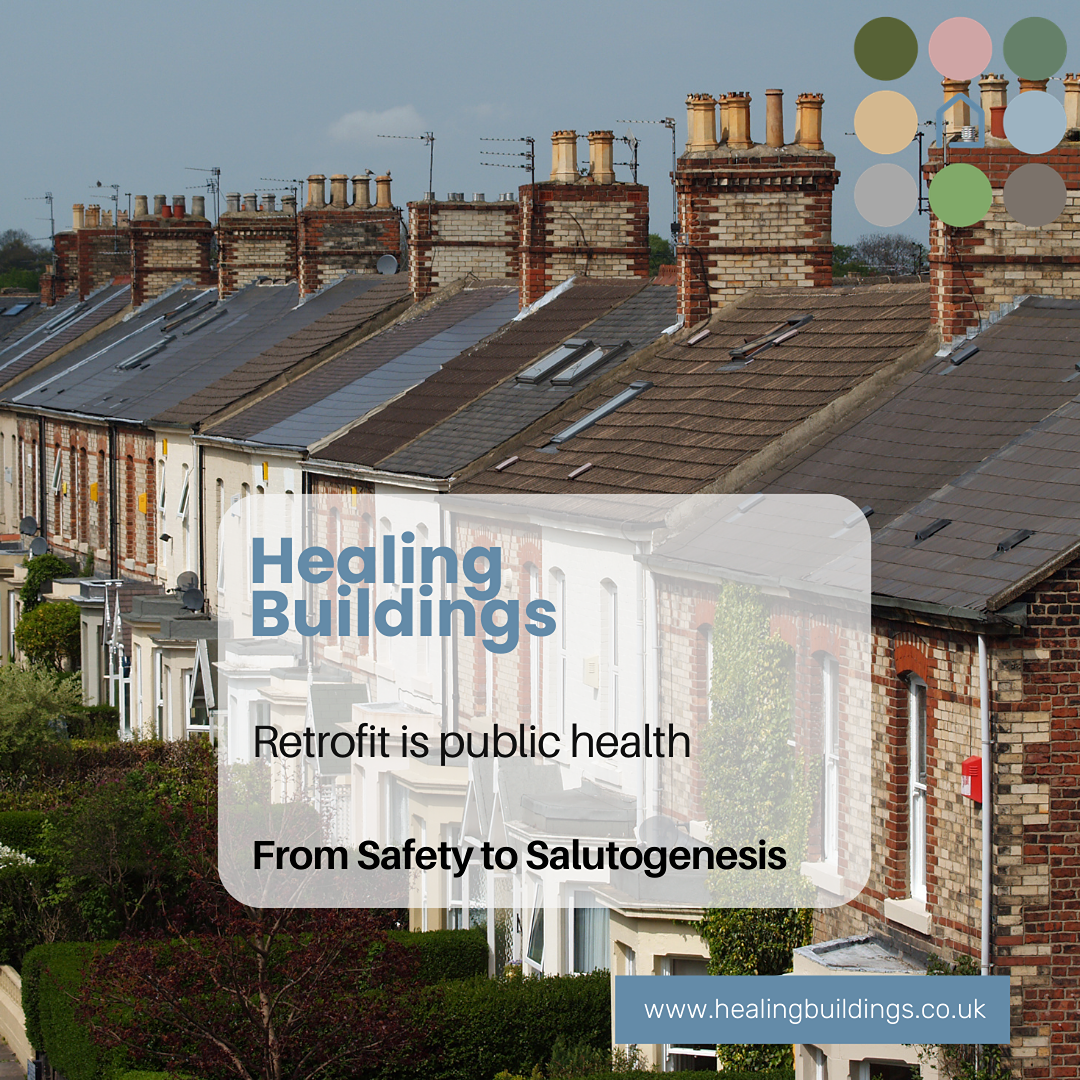
From safety to Salutogenesis - Home

The Home Is Health Infrastructure
Retrofit, Regulation and the Biology of Living Indoors
If health is now embedded in the regulatory vision for buildings, then the home becomes the most critical health infrastructure we have.
Not hospitals.
Not clinics.
Homes.
We spend around 80 to 90 percent of our lives indoors. For children, older people, those working remotely and those with long-term conditions, that percentage is often higher.
Yet housing policy has historically been framed through:
Supply
Affordability
Tenure
Energy efficiency
Asset value
Health has rarely been central.
That omission is no longer sustainable.
The House as a Biological System
A home is not simply shelter. It is a microclimate. A chemical environment. An acoustic field. A light ecosystem. An electromagnetic zone. A psychological container.
Every wall assembly influences moisture dynamics. It's what we as Architectural technologist spend alot of time dealing with.
Every material emits something.
Every window orientation alters circadian rhythm.
Every ventilation strategy shapes immune exposure.
Building biology has understood this for decades.
We should now be asking practical, measurable questions:
What volatile organic compounds are present?
Is there hidden mould growth?
What are indoor particulate levels?
How stable is relative humidity?
What electromagnetic exposures exist?
Are synthetic materials accumulating toxins?
These are not lifestyle concerns.
They are developmental variables.
Children’s immune systems are shaped by indoor exposure.
Respiratory illness is linked to damp and mould.
Cognitive performance shifts with CO₂ concentration.
Sleep quality is shaped by artificial light spectrum.
And still, most retrofit programmes lead with carbon.
Retrofit as Public Health Intervention
The majority of the homes that future generations will inhabit already exist.
They leak heat.
They trap moisture.
They overheat in summer.
They under-ventilate in winter.
Retrofit has rightly focused on energy performance and emissions reduction.
But when insulation is added without moisture strategy, we create mould risk.
When homes are made airtight without ventilation literacy, we create indoor air stagnation.
When windows are replaced without understanding daylight quality, we alter circadian regulation.
Carbon-first retrofit can unintentionally create health stressors.
If the regulatory system now embeds health in its first outcome, retrofit must evolve into public health infrastructure.
That means:
Indoor air quality as a primary metric.
Moisture modelling before insulation upgrades.
Daylight assessment beyond lux levels.
Material toxicity screening.
Overheating risk prioritised in vulnerable populations.
Regenerative retrofit goes further.
It asks:
Can this home improve biodiversity?
Can it harvest water responsibly?
Can it contribute to neighbourhood resilience?
Can it reduce stress rather than simply meet compliance?
That is not overreach.
That is systems thinking.
The Invisible Burden
Many health stressors in homes are invisible.
Mould behind plasterboard.
Formaldehyde off-gassing from furniture.
Acoustic stress from traffic.
Artificial light at night suppressing melatonin.
Electromagnetic exposure from device density.
Neuroarchitecture shows us that spatial stress accumulates.
Low ceilings, glare, cluttered visual fields and chaotic acoustics subtly activate stress responses.
Salutogenic design asks a different question from conventional regulation.
Instead of asking “How do we prevent illness?” it asks:
“How do we actively create coherence, manageability and meaning in the home?”
Does the space:
Offer visual calm?
Provide connection to nature?
Support predictable thermal comfort?
Enable control over light and sound?
Foster psychological safety?
Most building regulations do not ask those questions.
But health does.
New Homes: Repeating Old Mistakes?
We are building new housing at speed.
But speed is not synonymous with health literacy.
Many new homes:
Prioritise density over daylight.
Minimise window openings for energy targets.
Use synthetic material packages with high embodied toxins.
Provide limited outdoor interface.
Deliver minimal acoustic separation.
They may pass regulation.
But do they support flourishing?
Biophilic design is often reduced to adding plants or balconies.
In reality, it involves:
Fractal geometries.
Natural material tactility.
Multi-sensory variation.
Prospect and refuge balance.
Dynamic light patterns.
These are measurable influences on stress recovery and immune modulation.
Yet they are rarely core to housing procurement frameworks.
If health is now regulatory, biophilia cannot remain decorative.
Housing Inequality Is Health Inequality
The homes most likely to experience damp, overheating and poor air quality are often those occupied by the most vulnerable.
Social housing stock.
Temporary accommodation.
Older housing with minimal upgrades.
Rental properties with deferred maintenance.
If we accept that buildings shape biology, then housing inequality becomes health inequality in spatial form.
The new regulatory vision speaks of outcomes.
But outcomes must be equitable.
Should housing standards include:
Mandatory post-occupancy air testing?
Maximum internal summer temperature thresholds?
Material transparency requirements?
Health-based retrofit funding criteria?
If not, health risks remain stratified.
Regenerative design insists that we move beyond harm reduction.
It insists on repair.
Repair of buildings.
Repair of ecosystems.
Repair of social inequity.
Homes are where that repair must begin.
Education (Again)
The biggest barrier is not technology.
It is literacy.
Many contractors have never been trained in building biology principles.
Many designers have never studied circadian science.
Many housing providers are unfamiliar with salutogenic frameworks.
Many procurement officers cannot evaluate neuroarchitectural impact.
If health is regulatory, this must change.
Imagine a retrofit programme where:
Every project begins with indoor air assessment.
Every specification reviews chemical exposure.
Every design models overheating vulnerability.
Every contractor understands moisture dynamics.
Every housing officer understands mould as medical risk.
That would not slow the system.
It would stabilise it.
The Provocation
If a child develops asthma in a damp, poorly ventilated home, is that maintenance failure or design failure?
If an elderly resident overheats during summer due to inadequate shading, is that climate inevitability or regulatory gap?
If a working adult cannot sleep due to artificial light intrusion and acoustic stress, is that lifestyle or planning oversight?
Once health enters regulation, these questions become sharper.
Homes are not passive assets.
They are daily physiological environments.
And if we continue to treat them primarily as financial instruments, we will fail the very outcome the new regulatory vision declares.
Healing Begins at Home
The home is where immune systems form.
Where sleep cycles stabilise.
Where stress accumulates or dissolves.
Where belonging either strengthens or fractures.
If buildings must now deliver healthy environments, then the home is not the smallest unit of real estate.
It is the smallest unit of public health.
Retrofit must become regenerative.
New housing must become salutogenic.
Building biology must inform specification.
Neuroarchitecture must inform layout.
Biophilia must inform materiality and daylight.
This is not embellishment.
It is alignment with what regulation now implies.
Health in the law demands health in the living room.
And that is where the real work begins.